Military Religious Demographics
MAAF conducted six-month efforts in 2009 and 2012 to gather and review data on religious preference and chaplain diversity in the military. At the outset of the chaplaincy in the 18th century and even for part of the 20th Century, it is fair to say that the military and its chaplains were almost uniformly Protestant. The modern military includes over 100 religious preferences both among the general population and the chaplaincy, with the majority being Christian. These basic facts are well known, but specifics were hard to acquire.
MAAF has previous reports, including a 2002 Air Force study, and a 2004 study that included religious data. However, there were no truly comprehensive studies available, nor did they include studies of chaplain support, nor were they transparent with their data. MAAF solves these issues, providing a new study with raw data showing preferences of individual service members as well as chaplains. Our findings have been confirmed and expanded by other studies in the interim. Each of these studies are included below.
Viewing our nontheistic demographic in 2012, we found 0.5% self-identified as atheist or agnostic. While this may seem low, The Atheist religious preference was ahead of all responses except Christian or undetermined groups. The largest individual religious preference was No Religious Preference (see note below) at nearly 23% of the military. “Unknown” was the fifth-largest at 6.2%. After Twelve Christian selections (including two for no denomination), Atheist is in the #15 position. 88 different religious preferences, including 73 Christian denominations and all non-Christian denominations, fall below Atheist. We deserve and need support just as all service members do.
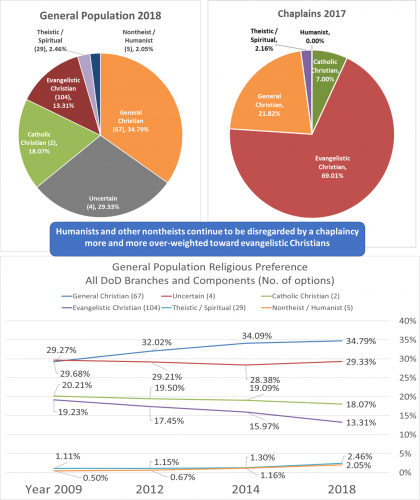
Chaplain support showed a Christian majority as expected, but the reality was that Christians fill nearly 97% of all chaplain billets while representing less than 70% of the general population. It seems that these Christian chaplains are especially willing to stand up for military service, and they should be applauded for serving. It may also be that Christians are given special privileges in Chaplain accessions while others face regulatory challenges. In addition, most “minority” religious groups like Jewish, Muslim, and LDS are overrepresented, per-capita, in the chaplaincy. Catholics are underrepresented and enjoy special emphasis in recruiting and military media. Atheists and humanists have no dedicated chaplain support or even attention in chaplain training despite being a relatively large minority in the general population. MAAF seeks to do our part by endorsing humanist chaplains, if the military will accept candidates.
There were few major differences between the 2009 and 2012 studies. The major difference was that the 2012 study included all active, reserve, and national guard chaplains (4796 total) and the 2009 study included only Active Duty (2928). Comparison by percentage mitigates the issue. In addition, the Air Force admitted that they did not keep proper records of the endorsers of chaplains and provided religious preference (eg, Presbyterian) rather than endorsing agency (eg, Presbyterian Church of North America, Presbyterian Church USA or National Association of Evangelicals). These distinctions are signifant. The Air Force reported 9 chaplains as “No Religious Preference”. Obviously these chaplains have a preference or else they would lose their endorsement and their job as chaplains. They were listed as “Other” in the data set.
The major categories selected (Catholic, Christian, Other, None) are common in religious demographics studies except for “Evangelistic.” This is not intended to be read as “Evangelicals.” The concern among many, including interfaith allies, is that the military and the chaplaincy is populated densely with Christians who may put conversion efforts ahead of their military duties. Endorsing agencies and denominations placed in this category appear to put a strong emphasis on the “Great Commission,” a passage interpreted by some to mean that Christians should convert others to obey Christian laws regardless what civilian authority teaches. The “Evangelistic” category identifies denominations that may warrant increased oversight due to their stated ecclesiastical priorities to convert others.
MAAF invites endorsing agencies, especially those in the “Evangelistic” category, to sign onto the MAAF Minimum Statement of Support and to encourage chaplains to comply with our http://blog.militaryatheists.org/2011/10/open-letter-to-chaplains-from-humanists/”>Open Letter to Chaplains. By showing support for atheists and humanists in the military, we can ensure equal treatment and move away from negative perceptions.
Note: No Religious Preference is the largest single demographic at nearly 23%. These personnel may be Christian, Catholic, Hindu, spiritual but not religious, atheist, or something else. Many Christian options are available, including non-denominational and general protestant, and there is no stigma against being Christian in today’s military. However, the fears for atheists and humanists is significant influencing many to choose “No Religious Preference” rather than being “outed” as an atheist. Some try to identify as atheist and are told that they have to choose “No Religious Preference.” Certainly the entire 23% is not comprised of atheist personnel, but there is good reason to believe the majority of that number are nontheistic. In any case, NRP is an important demographic for chaplains to serve, most likely with something other than the chaplain’s standard denominational services. Update: NRP has now been rolled into Unkown since “NRP” was dropped in 2017.
Demographic Studies
- 2019 Demographics report published 14 Nov 2019. Additional details to be posted as reviews continue. See initial article with pdf version and graphics.
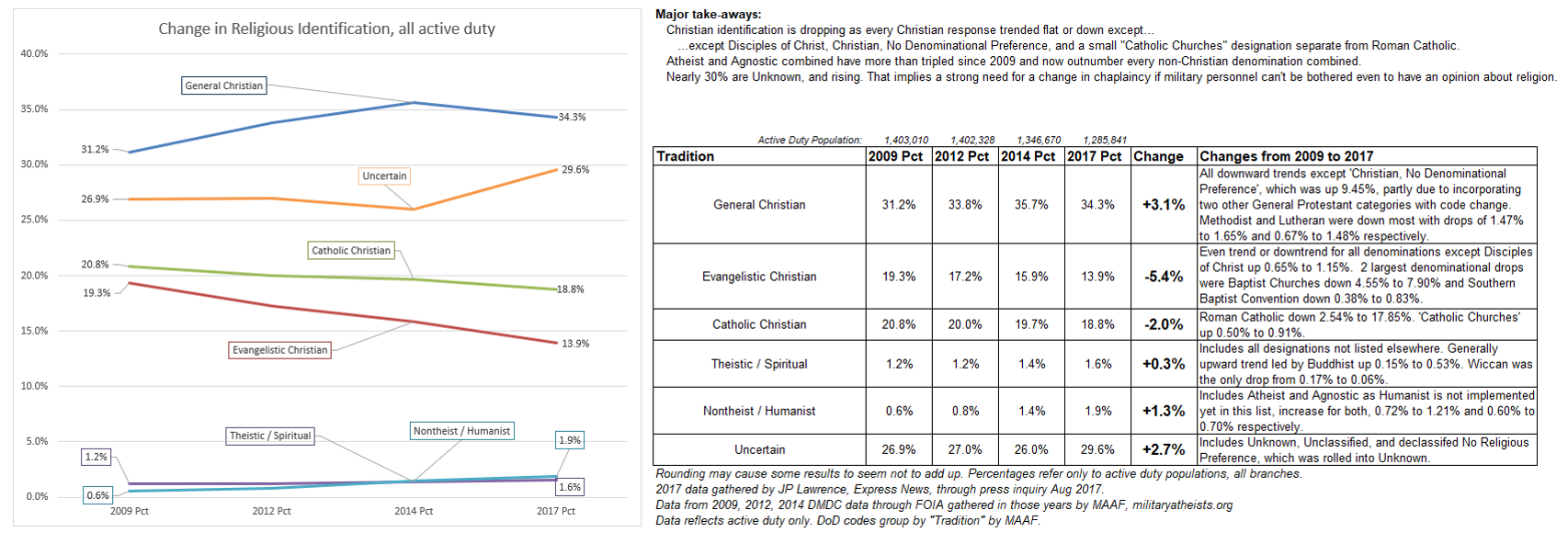
- 2017 religious demographics update Summary [png-image], all branches of service with comparison to 2009-2017. Shows 200% increase in nontheist identification since 2009, now outnumbering all non-Christian denominations combined.
- 2017 Update of DoD religious demographics ‘Faith and Belief Codes’. See related articles – summary, in-depth.
- 2014 Update of Military Religious Demographics PDF Summary. Information gathered through FOIA by MAAF, compiled, and compared with 2009 results. Excel details of 2009-2014 religious demographics changes (updated with map to new 2017 faith group codes)
- 2012 MAAF Department of Defense Religious Preference and Chaplain Support Study (2012 data, published July 2012): MAAF 2012 DoD Religious Preference and Chaplain Study. The primary tab includes the chaplain population vs the general population and breakouts for minority communities. The other tabs include raw data and listings ordered by size. This also includes the 2010 data (which was gathered in 2009). This data should be reviewed only in the context of the commentary above and in the files themselves. Contact MAAF for questions or permission for special uses.
- 2010 MAAF Department of Defense Study version 2 (updated April 2011): Source Data. This is the basis of the commentary written above. See data image
- 2010 MAAF DoD Study v1 (January 2010): Presentation and Source Data and image 1 and image 2. Version 2 changes the approach by separating the atheist and no religious preference categories based on feedback from chaplains and endorsers. Minor errors were corrected and the text for this page was reworked to better explain the results and purpose of the study.
- University of Chicago Study of religious beliefs around the world. Raw data tables
- The Military Leadership Diversity Commission reports a new Equal Opportunity survey indicating 25.5% No Religious Preference and 3.61% Humanist (equated with Atheist & Agnostic). View study here (Original Link was removed)
- The Population Reference Bureau, an independent, private data analysis agency, shows military atheists comprise more than 20% of the population: PRB Report
- Airforce 2002 enlisted and officer religious demographics.